Understanding the
Light/Fragmented Sleeper.
A clinical analysis of the continuity failure driving non-restorative sleep.
Sleep That Won't Stay.
Your profile reveals a structural failure in sleep continuity, not initiation. You easily fall asleep, but your nervous system cannot consolidate those hours into sustained recovery.
The night fractures into shallow, interrupted cycles. Without architectural depth, even minor disturbances pull you back to the surface.
Too Close to the Surface.
Your cycles are structurally shallow, lingering in light stages with dangerously low arousal thresholds. The brain never descends into sustained deep recovery.
The Consolidation Failure
Fragmentation blocks slow-wave and REM phases, halting physical repair and hormonal regulation.
Exhaustion stems from instability, not duration. You wake tired because your sleep never stabilized long enough to restore.
What Breaks It.
Fragmentation is a mechanical reaction to physiological and behavioral triggers. These forces actively prevent the brain from consolidating a continuous recovery block.
Key Insight
Alcohol, caffeine, irregular schedules, and environmental noise lower your arousal threshold, rendering every cycle fragile.
Anticipatory waking compounds this damage. Once the nervous system expects interruption, it monitors for it, turning broken sleep into a self-reinforcing loop.
How to Hold the Night.
Stabilization requires eliminating destabilizers while physiologically reinforcing the nervous system’s capacity to hold depth.
Anchor the Rhythm
Lock your sleep and wake times. Circadian predictability increases your biological capacity to sustain deep sleep.
Lower the Noise Floor
Eliminate chemical and environmental friction. Alcohol, late caffeine, and ambient light artificially lower your arousal threshold.
Reinforce Depth
Mechanically support the nervous system. Holding parasympathetic depth minimizes surface-level awakenings.
The Missing Condition.
Fragmentation persists when the nervous system cannot sustain parasympathetic depth. Sleep initiates, but fails to protect itself from micro-arousals.
Cranial Electrotherapy Stimulation (CES)
Alpha-frequency microcurrents (8-13Hz) establish a stable neurological baseline, allowing fragile sleep architecture to consolidate.
CES acts as a mechanical stabilizer, not a sedative. It reinforces the physiological conditions required to resist interruption.
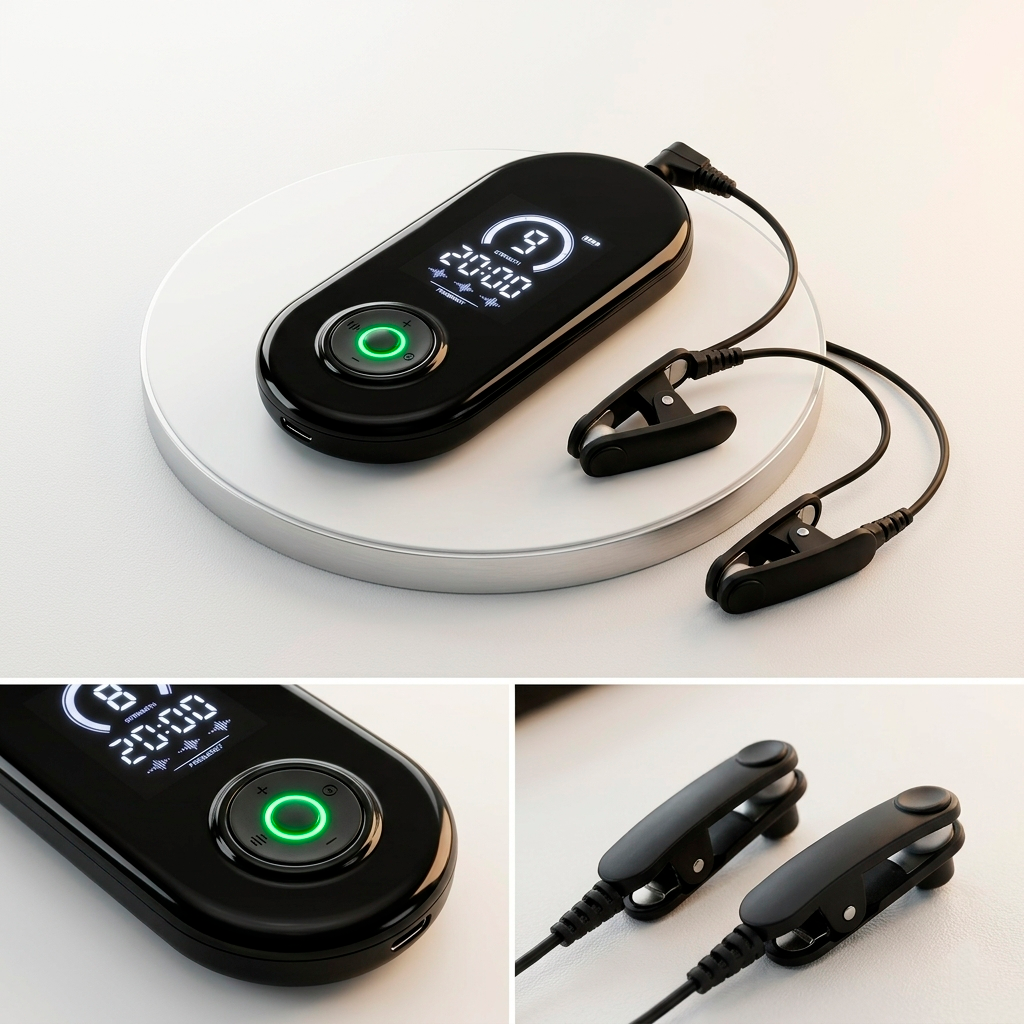
Explore AC-SS™ (v2.0) - FDA Cleared CES DeviceAC-SS™ (v2.0) —
Precision for the Fragmented Sleeper.
An FDA-cleared cranial electrotherapy device, precision-calibrated to stabilize your neurological baseline.
Alpha entrainment (8–13 Hz). Reinforces the required conditions for uninterrupted sleep architecture.
Non-chemical. Zero dependency, tolerance, or morning fog. Pure mechanical intervention.
FDA cleared. Clinically validated for insomnia and anxiety through rigorous peer-reviewed research.
Sleep that holds.
Your problem is not a lack of sleep. It is a failure to hold it.
True recovery demands architectural depth that consolidates and actively resists interruption.
Do not aim to sleep longer. Aim to sleep without breaking.